Choosing a web designer is not really about finding someone who can make a nice-looking page. Plenty of nice-looking pages sit online doing absolutely nothing. The better question is: who can turn your business into a website that customers understand, trust and use?
That distinction matters for small businesses because the website usually has a commercial job. It needs to bring in enquiries, support referrals, explain services, reassure cautious buyers, show proof and make the next step easy on a phone. If the finished site only looks polished in a portfolio, but leaves visitors wondering what to do next, you have bought decoration with hosting.
Current guides on choosing a web design company tend to agree on the broad checks: define goals, review relevant work, understand the process, compare what is included, check communication and look for support after launch. Network Solutions frames the choice around business goals, audience needs, process and measurable outcomes, while Orbit Media's agency-side guide focuses on asking sharper questions before committing. Network Solutions' web design company guide Orbit Media's questions for choosing a web designer
Start with the job, not the style
Before you ask for quotes, write down what the website must do. Does it need to earn quote requests, bookings, calls, walk-ins, online sales, audit starts or trust before a bigger conversation? A designer cannot make the right decisions if the project brief only says "make it modern" and "we like clean websites".
Style still matters. A messy or dated site can damage trust. But style is not the strategy. A florist, accountant, salon, tradesperson and consultant may all want a professional website, but the pages, proof, calls to action and customer objections are different. The right designer should ask about customers, services, locations, pricing anxiety, proof, competitors and what happens after an enquiry.
This is also where a free site audit can help before you buy anything. If your current website is already being missed, misunderstood or ignored, the audit gives you a clearer starting point than choosing a designer from screenshots alone.
Decide what kind of help you actually need
There are three common routes: freelancer, agency and managed website service. A freelancer can be a good fit when the job is focused, the scope is clear and you want a direct working relationship. A small studio or agency can be useful when the site needs more people: strategy, design, development, copy, ecommerce, brand work or campaign support.
A managed website service is different. It is not just a one-off design project. It is for owners who want the website built, hosted, updated and improved without learning another website platform or remembering every small fix themselves. That matters if the site is close to revenue and cannot be left to drift after launch.
The route should match your business, not your anxiety level on quote day. If you have time and confidence, a freelancer or DIY builder may be enough. If the website needs ongoing content, search visibility, support, measurement and conversion improvement, compare one-off design quotes against website management services and website support services, not just against the first build price.
Check what is actually included
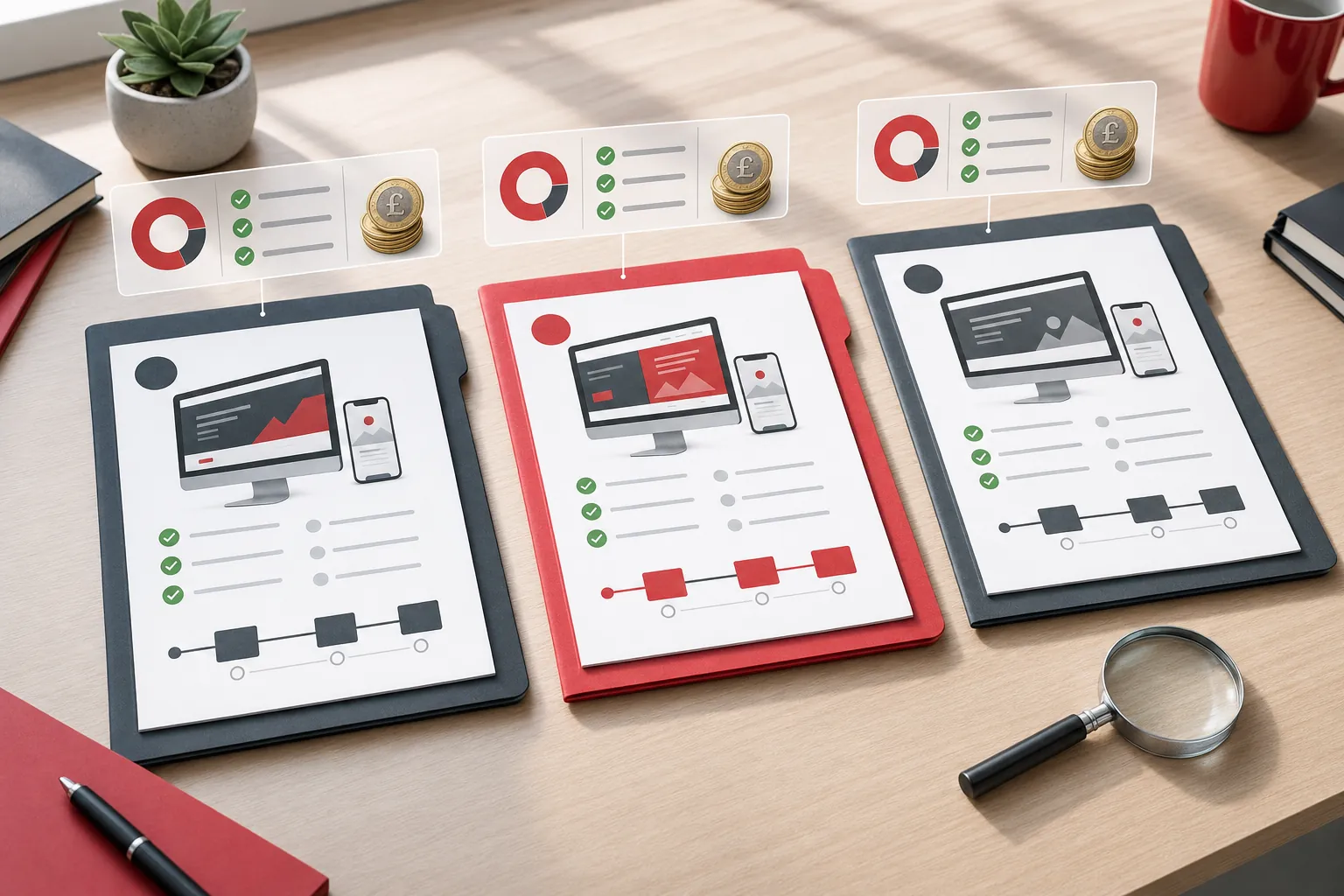
Web design quotes are awkward to compare because two providers can use the same words and mean different things. "Five-page website" might include page planning, copywriting, image sourcing, mobile review, forms, analytics, privacy links and launch support. Or it might mean five empty-looking pages waiting for you to supply everything.
Ask exactly who handles the copy. This is one of the biggest hidden gaps. Many weak websites do not fail because the colours were wrong; they fail because the owner was left to write every page, then filled the site with safe phrases like "quality service" and "tailored solutions". A good provider should help turn what you know into plain customer language.
Ask about mobile checks, enquiry forms, redirects from old pages, basic search setup, accessibility, analytics and post-launch changes. Google's people-first content guidance is useful here because it asks whether a page gives readers enough useful information to achieve their goal. That standard applies to a service website as much as an article. Google's people-first content guidance
Review the portfolio like a customer, not a designer
A portfolio should show more than taste. Open the examples and behave like a customer. Can you tell what the business does within a few seconds? Is the main action clear? Does the page work on a phone? Are the services understandable? Is there proof near the claims? Do the pages feel written for a buyer, or do they sound like a design exercise?
Pretty screenshots can hide weak customer journeys. A site can look great at the top and still bury contact details, avoid pricing clues, skip FAQs, use vague service labels or make every page sound interchangeable. Ask the designer why they made choices on a project. If they can explain the customer problem and commercial decision, that is a better sign than another moody homepage crop.
For a small business, look for examples close to your reality. Not necessarily your exact industry, but your type of job: local services, professional services, ecommerce, bookings, high-trust advice, fast enquiries, or content-led selling. Relevant thinking matters more than whether they once built something for a famous brand.
Ask how the site will be found
A website designer does not need to promise miracle rankings. In fact, be careful if they do. But they should understand the basics that help a site become findable: clear page titles, useful headings, focused service pages, crawlable links, sitemap inclusion, mobile quality, fast images and content written around real customer questions.
Ask how they decide which pages the site needs. If every service is squeezed into one vague page, the site may be harder for customers and search engines to understand. 118 118 Sites uses focused pages for small-business website design, small-business SEO services, local SEO services and related work because different searches and buying questions deserve clearer answers.
Also ask what happens to old URLs if you already have a website. A redesign can accidentally remove pages that were earning visits, links or trust. The right provider should preserve useful pages, improve weak ones and send old addresses to the closest relevant new page rather than dumping everything onto the homepage.
Look for mobile, accessibility and speed discipline
A website is not finished because it looks good on the designer's big screen. Customers will open it on phones, tablets, older laptops and patchy connections. Ask how mobile is reviewed. Check tap targets, forms, menus, image crops, cookie choices, line breaks and whether the main action is visible without a scavenger hunt.
Accessibility belongs in the same conversation. The Web Content Accessibility Guidelines explain how to make web content more accessible to people with disabilities, with principles around content being perceivable, operable, understandable and robust. You do not need to become an accessibility specialist to ask sensible questions about contrast, keyboard use, labels and meaningful image text. W3C's WCAG overview
Speed is similar. Google PageSpeed Insights is a useful public check because it helps spot slow pages and mobile performance issues. A perfect score is not the whole job, but a slow page with oversized images and jumpy layout is a poor first impression. Google PageSpeed Insights
Understand ownership, access and legal basics
Ask who owns the domain, the website account, the content, the images and the finished files where that applies. Ask what happens if you leave. Ask whether you can export content, move platform, add another supplier or keep the site live without a messy dispute. These questions are not rude. They are normal business hygiene.
Also check privacy, cookies and forms. If the site collects enquiries, runs analytics, takes bookings, sells products or uses advertising pixels, it needs the right policy pages, consent choices and data handling for the business. The ICO says organisations should give clear information about cookies and consent, and optional features should not simply be switched on by default. ICO guidance on cookies and similar technologies
Do not expect a designer to be your solicitor. Do expect them to know that these surfaces exist and to leave clean routes for your approved policy wording, cookie choices and contact details. A serious business website should not hide the basics that help customers trust who is behind it.
Compare proposals by outcome, not page count
A bigger proposal is not automatically better. A smaller quote is not automatically worse. Compare the work that affects the customer journey: research, page structure, copy, design, mobile review, forms, tracking, launch support, old-page protection, legal wayfinding, content handover and ongoing updates.
Watch for vague deliverables. "SEO included" can mean anything from sensible page titles to a generic plugin setting. "Support included" might mean thirty days of bug fixes, or it might mean genuine help when the site needs updates. "Custom design" might mean thoughtful business-specific pages, or a template with your logo swapped in. Ask until the words become concrete.
If cost is the main worry, use the website cost guide alongside each quote. The cheapest route can be right for a simple proof-of-existence site. It is riskier when the website has to win real enquiries and nobody has included the work that makes those enquiries more likely.

Ask what happens after launch
This is where many web design projects quietly fail. The site launches, everyone says it looks good, and then it sits there while services change, questions change, competitors improve, reviews arrive, images age and the owner forgets how to update the page. A website is not a brochure you laminate. It is a working sales route.
Ask who checks performance after launch. Who fixes broken links? Who updates services? Who improves a page that gets visits but no enquiries? Who adds a useful guide when customers keep asking the same question? Who checks that forms still work? If the answer is "you", make sure you actually want that job.
This is where 118 118 Sites is deliberately different from a one-off design handover. The Grow traffic work is built around steady improvement after launch: clearer pages, useful articles, internal links, technical checks, mobile polish and better routes from search to enquiry.
Watch for red flags
Be careful with pressure to decide quickly, promises that sound too clean, unclear ownership, no written scope, no examples, no questions about your business, no mention of mobile, no support plan, no explanation of what you need to provide, and pricing that hides the expensive parts until later.
Also be careful with providers who talk only about design trends. Trends are not useless, but customers do not enquire because a section uses the fashionable corner radius of the month. They enquire because the page answers their problem, proves the business is credible and makes the next step feel easy.
A good provider should make the decision calmer. They should explain the process, show what is included, tell you where the risks are and ask enough questions to understand the business. If the sales process already feels confusing, the build probably will not become magically clearer later.
Use this practical checklist
- Define the one job the website must do before asking for prices.
- Check real examples that match your type of business and customer journey.
- Compare what is included: copy, mobile, search setup, forms, launch and support.
- Ask who improves the site after it goes live.
- Avoid vague promises, hidden costs and pressure to decide quickly.
- Choose the route that gives you a clearer, trusted website customers can act on.
How 118 118 Sites helps
118 118 Sites is for owners who want the website outcome without inheriting a second job. The process starts by checking what is stopping the current site from being found, trusted or acted on, then rebuilds the missing pieces and keeps improving the site after launch.
That matters because a website design decision is not just about who can make the nicest first version. It is about who keeps the site useful once real customers and search data start showing what needs attention. A site that is improved regularly has a better chance of becoming a working source of enquiries instead of another forgotten business expense.
If you are comparing designers now, start with the free site audit. Then use pricing and proof to compare 118 against a one-off design quote on what actually matters: clarity, trust, visibility, support and ongoing improvement.
Frequently asked questions
How do I choose a web designer for a small business?
Start with the job the website must do, then check whether the designer has relevant small-business experience, a clear process, transparent pricing, strong mobile work, useful copy and search thinking, and proper support after launch. The right choice is not simply the cheapest portfolio you like; it is the partner most likely to turn your business into a website customers can understand and act on.
Should I choose a freelancer, agency or managed website service?
A freelancer can suit a focused project with a clear scope. An agency can suit larger or more complex work. A managed website service suits owners who want the site built, supported and improved without becoming the website manager themselves. Choose by the work included and the support you need after launch, not by the label on the provider.
What should I ask before hiring a web designer?
Ask what is included, who writes the copy, how mobile is checked, how search basics are handled, what happens to old URLs, how revisions work, what support is included after launch, who owns the website assets, and how success will be measured. A good provider should answer plainly without making you feel silly for asking.
Is the cheapest web designer a bad idea?
Not always, but a very cheap quote often moves important work back to you: planning, copy, images, mobile checks, forms, legal links, search setup and updates after launch. Cheap is fine when the job is genuinely simple and expectations are clear. It becomes expensive when the finished site looks tidy but brings no useful enquiries.